No CSE permits. No standby rescue. No scaffold. Fly a camera in and get inspection-grade answers in minutes.
Every plant manager knows the math. Sending a crew into a tank, boiler, or shaft means confined space entry (CSE) permits, standby rescue teams, atmospheric testing, and the slow creep of liability that follows every sign-off. When something goes wrong, the numbers are catastrophic. When nothing goes wrong, the cost is still enormous — and rising.
Confined space inspection drones exist to change that equation. Instead of clearing a space for human entry, you fly in a camera. Instead of scaffolding, you get live HD video. Instead of days, you get answers in minutes.
This page explains what confined space inspection drones actually do, what separates a purpose-built industrial tool from a general-purpose quadcopter, and how the Nolvis X1 was designed around the specific demands of close visual inspection (CVI) in the tightest spaces your facilities present.
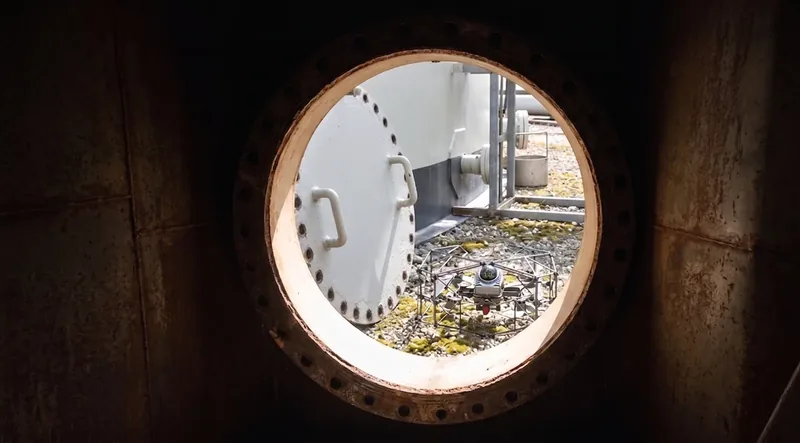
Consumer drones fly GPS-stabilized in open air. Confined spaces offer none of that: no GPS signal, unpredictable air currents from ventilation, metal walls that disrupt magnetic compasses, and apertures that would stop most drones before they start. The inspection itself demands controlled, slow movement in near-total darkness, close enough to the surface to capture corrosion, cracking, or coating failure — not a flyover.
Purpose-built confined space drones solve for all of this: protective cages that survive wall contact, lighting systems strong enough to illuminate dark tank interiors, and stabilization that doesn't rely on GPS.
The Nolvis X1 is a 14-inch-class cage-protected drone built exclusively for close visual inspection. It navigates openings as tight as 16 inches. Its 4K camera and 10,480-lumen lighting system were selected for darkened interior environments where detail matters. The controller and tablet interface are designed to be stable and readable under field conditions — not in a lab.
The result is a drone that plant managers describe as genuinely easy to fly from the first session, and capable of capturing inspection-grade imagery in a single pass.
Across power generation, oil & gas, and mining applications, confined space drone inspections have demonstrated consistent outcomes: inspection time reductions of 90%+, elimination of CSE entirely for visual inspection phases, and cost savings measured in the tens of thousands per asset per inspection cycle.
The specific numbers vary by asset type and facility. What doesn't vary is the direction: faster, cheaper, safer.
If your facility includes tanks, boilers, shafts, or any other confined space that requires periodic visual inspection, a confined space inspection drone is no longer a future consideration. It's a current procurement decision.
Purpose-built confined space drones vary in frame size. The Nolvis X1 passes through openings as small as 16 inches. Some larger models require 18-inch or wider access points. Always confirm your smallest access opening before selecting a drone.
For close visual inspection (CVI), drones can conduct the inspection without requiring any human to enter the confined space. Interpretation of findings and certification decisions typically still involve a qualified human inspector reviewing the footage and issuing reports.
Full-featured legacy systems with LiDAR and 3D mapping can reach $50,000–$150,000+. The Nolvis X1 is priced at less than one-third the cost of legacy CVI systems, and typically fits OPEX budgets. Request a quote from Nolvis or an authorized distributor.
Tell us your asset and your smallest opening — we'll advise. No demo required to start.
