The market leader makes excellent drones. Not everyone needs everything they carry — or the price that comes with it. Here's how to decide.
The established caged-drone platforms are serious products: robust, mature software ecosystems, LiDAR-based 3D mapping. If you need full-featured point clouds and have the budget, they deserve a place on your shortlist.
But not everyone needs LiDAR-first workflows. And not everyone has $50,000–$150,000+ to spend. If you're comparing your options, you're probably in one of these situations:
This page gives you a fact-based comparison so you can make the right call.
| Nolvis X1 | Legacy 20″-class caged systems | |
|---|---|---|
| Indicative price tier | Less than 1/3 the cost | $50,000–$150,000+ |
| Primary use case | CVI + 3D point cloud (onboard LiDAR) | CVI + LiDAR 3D mapping |
| Frame size | 14-inch class | 20-inch class |
| Smallest access opening | ~16 inches | Larger than 18 inches |
| Fits standard 18″ manways | ✓ Yes (validated on-site) | ✗ No |
| LiDAR / 3D point cloud | ✓ Yes (200,000 pts/s, LiDAR-stabilized flight) | ✓ Yes |
| Camera | 4K, inspection-grade | High |
| Lighting | 10,480 lumen (max) | Varies |
| Typical US approval path | OPEX (plant-manager level) | Often CAPEX at $100K+ |
| Annual maintenance | $4,000/yr (Nolvis Care) | Varies by reseller |
| Best for | CVI-focused programs, fleet scaling, budget-constrained buyers | LiDAR-first full-feature programs |
Comparisons are based on publicly available information and may vary by configuration, region, and reseller. Verify current specifications and pricing directly with each vendor.
The compact caged drone that many inspection teams standardized on has been discontinued by its manufacturer. If you're running one and looking to replace or supplement it, your options are:
For CVI-centered programs, the X1 is the most direct functional equivalent — at less than one-third the price of the flagship path — and it still delivers an onboard LiDAR 3D point cloud (200,000 points/s) alongside the visual inspection. If survey-grade, downward-focused 3D volumetrics are your primary deliverable, evaluate the flagship's mapping suite against that specific requirement.
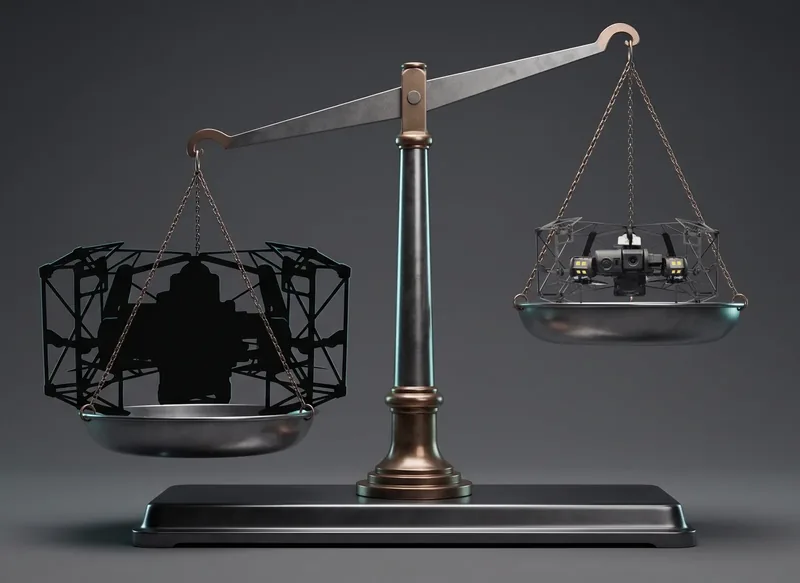
This is a practical consideration that often drives the decision. Current 20-inch-class systems require larger openings to pass through. If your facility has access points of 18 inches or smaller — standard tank manways, boiler ports, older industrial installations — those systems physically cannot enter them. The X1, at 14-inch class, can.
The X1 is a strong fit if:
The X1 is not the right fit if:
The X1 system includes the aircraft, tablet controller, and Nolvis Cloud reporting. Nolvis Care maintenance coverage ($4,000/year) adds parts and cage replacement, loaner unit access up to 3×/year, and technical support. Dual-unit packages with extra batteries and range extenders are available for fleet programs.
For inspection service companies, the economics are particularly clear: the X1 can be deployed on a single client engagement, billed against that project, and recover its cost before the second inspection begins. Pricing is set by Nolvis and authorized distributors — request a quote.
For CVI (close visual inspection) workflows, yes. The X1 is positioned as a CVI-focused drone in a similar size and capability range to the discontinued compact-class systems, at a significantly lower price point — a natural evaluation point for teams looking to replace or supplement their fleet.
Price (less than one-third the cost), frame size (14-inch class vs. 20-inch class), and focus. The X1 is CVI-first with an onboard LiDAR point cloud included; legacy flagships are LiDAR-first full-feature platforms. For operations centered on visual inspection, the X1 delivers the core function — plus 3D context — at a fraction of the cost.
Yes. The X1 is a 14-inch-class drone that passes through openings as small as 16 inches — including standard 18-inch manways where 20-inch-class systems cannot fit. For facilities with constrained access points, the X1 can enter spaces larger drones cannot.
Request a side-by-side demo — bring your smallest opening, and we'll bring the X1.
