Hang-ups, scaling, liner damage — assessed on video, with every person at a safe distance. Benchmark: 8 hours → 20 minutes.
Ore passes, draw points, ventilation shafts, and stopes are critical underground voids — and they degrade. Hang-ups, wall scaling, liner damage, and blockages all need to be assessed before they become safety or production problems. The trouble is that inspecting them the traditional way means rope access, specialized cavity scanning, or stopping production to get a person near the void. All three are slow, expensive, or dangerous.
A close visual inspection (CVI) drone changes that. You fly a camera into the void, capture its condition, and keep every person at a safe distance.
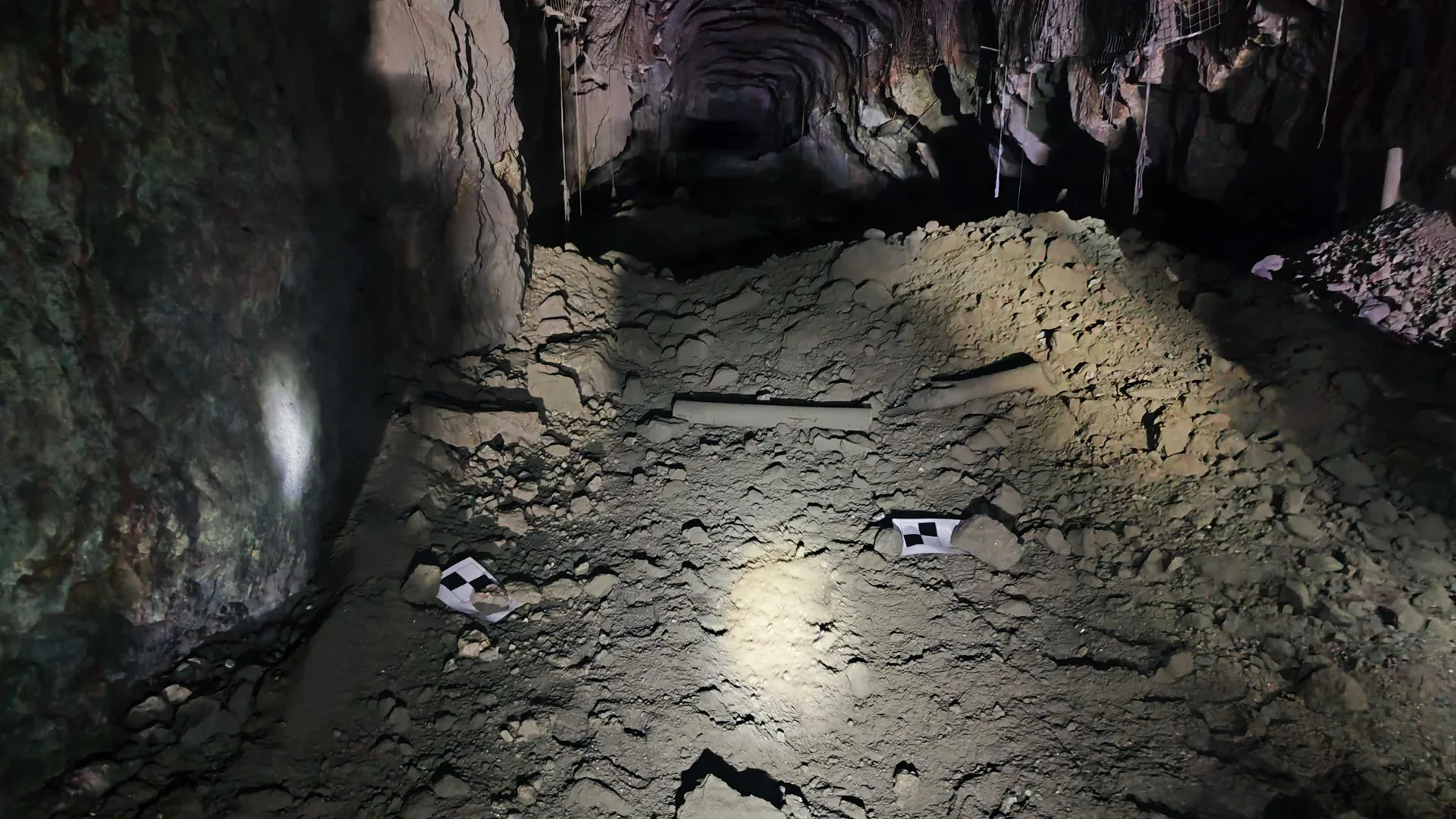
Ore passes and draw points offer no GPS, heavy dust, water, irregular geometry, and the constant risk of falling material. A consumer drone fails immediately. Purpose-built underground inspection drones solve for this with protective cages that survive contact, lighting strong enough to read wall condition in total darkness, and stabilization that doesn't depend on GPS or a clean magnetic environment.
The drone does not replace the surveyor or geotechnical engineer — it removes the access problem. The drone is flown into the ore pass or draw point, footage is captured systematically across the walls, hang-up zone, and liner, and the surveyor reviews the footage to assess condition and plan remediation. No personnel are exposed to the void.
The Nolvis X1 is a 14-inch-class, cage-protected drone designed for close visual inspection in tight, unstructured spaces. Its 10,480-lumen lighting is built for dark interiors, and its flight characteristics are tuned for slow, controlled inspection rather than open-air speed.
At less than one-third the cost of legacy CVI systems, the X1 is typically approvable as OPEX — no capital authorization. A single avoided rope-access campaign or production stoppage usually covers the cost.
The strongest reference point in the industry: a major underground iron ore mine documented an ore pass inspection reduced from 8 hours to 20 minutes (~97.5%) using a comparable CVI drone approach (industry benchmark). The exact savings at your site depend on the method you replace — rope access, contractor scanning, or lost production — but the direction is consistent: faster, cheaper, and with no one near the void.
If your operation includes ore passes, draw points, ventilation shafts, or stopes that need periodic visual assessment, an ore pass inspection drone is a current procurement decision, not a future one.
Yes. Purpose-built CVI drones fly into ore passes, draw points, and ventilation shafts and capture visual condition (hang-ups, wall scaling, liner damage, blockages) without exposing personnel. A surveyor or geotechnical engineer reviews the footage and plans remediation.
ATEX (or equivalent) certification may be required in certain underground environments. The X1 is designed for visual inspection in non-explosive atmospheres. Confirm your site's certification requirements before deployment.
A documented industry case reduced ore pass inspection from 8 hours to roughly 20 minutes (~97.5%). Actual savings depend on the inspection method being replaced and the production impact of stopping for access.
Tell us your void geometry and access constraints — we'll advise on fit before any commitment.
